


Page 33 - BOPHELO - Life - 2026
P. 33
Closing the African Genomics Gap

            Despite Africa’s rich genetic diversity, most genomic research
            has focused on European and Asian populations. This
            underrepresentation limits understanding of how medicines work,
            how diseases develop, and how interventions should be tailored for
            African communities.
            The GP addresses this gap by producing population-representative
            datasets that reflect African biology, empowering local scientists to
            become knowledge producers rather than just users of international
            data. Collaborative projects include studies on rare diseases,
            cancer, infectious diseases, and other health challenges, ensuring
            that research translates into practical benefits for African patients.


            Training, Innovation, and Health Impact


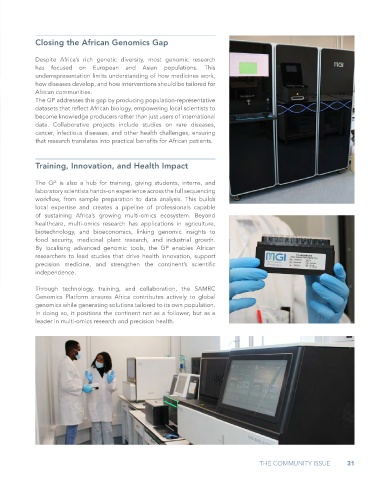
            The GP is also a hub for training, giving students, interns, and
            laboratory scientists hands-on experience across the full sequencing
            workflow,  from  sample  preparation  to  data  analysis.  This  builds
            local expertise and creates a pipeline of professionals capable
            of  sustaining Africa’s  growing multi-omics ecosystem.  Beyond
            healthcare, multi-omics research has applications in agriculture,
            biotechnology, and bioeconomics, linking genomic insights to
            food security, medicinal plant research, and industrial growth.
            By localising advanced genomic tools, the GP enables African
            researchers to lead studies that drive health innovation, support
            precision  medicine,  and  strengthen  the  continent’s  scientific
            independence.

            Through technology, training, and collaboration, the SAMRC
            Genomics Platform ensures Africa contributes actively to global
            genomics while generating solutions tailored to its own population.
            In doing so, it positions the continent not as a follower, but as a
            leader in multi-omics research and precision health.


                                                                                    THE COMMUNITY ISSUE         31

