


Page 31 - BOPHELO - Life - 2026
P. 31
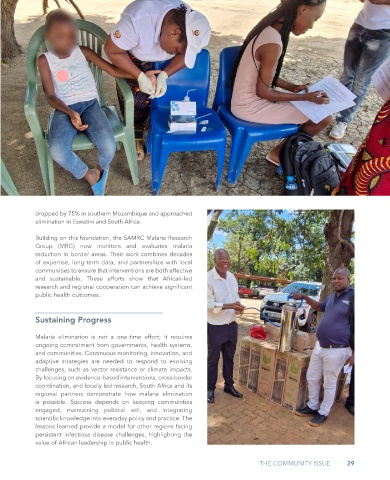
dropped by 75% in southern Mozambique and approached
            elimination in Eswatini and South Africa.

            Building on this foundation, the SAMRC Malaria Research
            Group (MRG) now monitors and evaluates malaria
            reduction in border areas. Their work combines decades
            of expertise, long-term data, and partnerships with local
            communities to ensure that interventions are both effective
            and sustainable. These efforts show that African-led
            research and regional cooperation can achieve significant
            public health outcomes.


            Sustaining Progress

            Malaria elimination is not a one-time effort; it requires
            ongoing commitment from governments, health systems,
            and communities. Continuous monitoring, innovation, and
            adaptive strategies are needed to respond to evolving
            challenges, such as vector resistance or climate impacts.
            By focusing on evidence-based interventions, cross-border
            coordination, and locally led research, South Africa and its
            regional partners demonstrate how malaria elimination
            is possible. Success depends on keeping communities
            engaged, maintaining political will, and integrating
            scientific knowledge into everyday policy and practice. The
            lessons learned provide a model for other regions facing
            persistent infectious disease challenges, highlighting the
            value of African leadership in public health.


                                                                                    THE COMMUNITY ISSUE         29

