


Page 25 - BOPHELO - Life - 2026
P. 25
Today, more than 12 companies collaborate with the
            programme, showing increasing trust and demand.

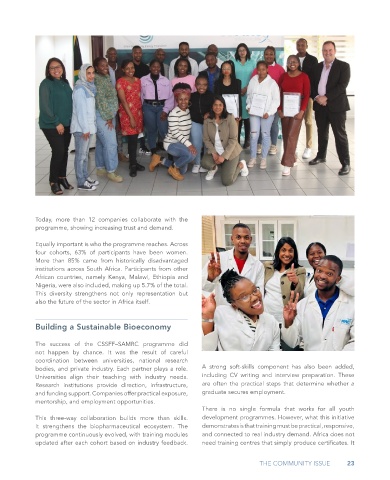
            Equally important is who the programme reaches. Across
            four cohorts, 63% of participants have been women.
            More than  85% came  from  historically  disadvantaged
            institutions across South Africa. Participants from other
            African countries, namely Kenya, Malawi, Ethiopia and
            Nigeria, were also included, making up 5.7% of the total.
            This diversity strengthens not only representation but
            also the future of the sector in Africa itself.


            Building a Sustainable Bioeconomy

            The success  of the CSSFF–SAMRC programme did
            not happen by chance. It was the result of careful
            coordination between universities, national research
            bodies, and private industry. Each partner plays a role.   A strong soft-skills component has also been added,
            Universities  align their  teaching with  industry needs.   including CV writing and interview preparation. These
            Research institutions provide direction, infrastructure,   are often the practical steps that determine whether a
            and funding support. Companies offer practical exposure,   graduate secures employment.
            mentorship, and employment opportunities.
                                                                  There is no single formula that works for all youth
            This three-way  collaboration  builds more than  skills.   development programmes. However, what this initiative
            It strengthens the biopharmaceutical ecosystem. The   demonstrates is that training must be practical, responsive,
            programme continuously evolved, with training modules   and connected to real industry demand. Africa does not
            updated after each cohort based on industry feedback.   need training centres that simply produce certificates. It


                                                                                    THE COMMUNITY ISSUE         23

