


Page 23 - BOPHELO - Life - 2026
P. 23
Why Imported Models Fall Short

            Currently, the equations and diagnostic tools used to
            detect CKD in African settings are often developed in
            Europe, North America, or Asia. These tools do not
            always reflect the genetic, dietary, and environmental
            differences  present  in  African  populations.  For
            example, creatinine-based equations used to estimate
            kidney  function  can  be  influenced  by  muscle  mass
            and nutrition, leading to inaccurate results if applied
            without adjustment.

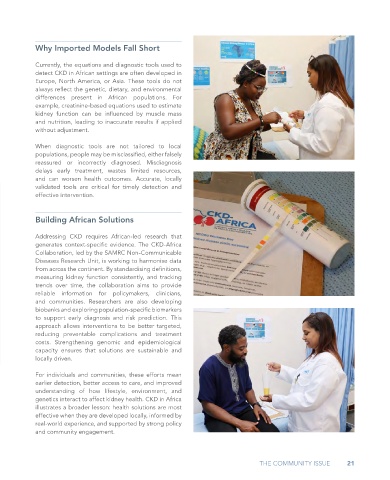
            When diagnostic tools are not tailored to local
            populations, people may be misclassified, either falsely
            reassured or incorrectly diagnosed. Misdiagnosis
            delays early treatment, wastes limited resources,
            and can worsen health outcomes. Accurate, locally
            validated tools are critical for timely detection and
            effective intervention.


            Building African Solutions

            Addressing CKD requires African-led research that
            generates  context-specific  evidence.  The  CKD-Africa
            Collaboration, led by the SAMRC Non-Communicable
            Diseases Research Unit, is working to harmonise data
            from across the continent. By standardising definitions,
            measuring kidney function consistently, and tracking
            trends over time, the collaboration aims to provide
            reliable information for policymakers, clinicians,
            and communities. Researchers are also developing
            biobanks and exploring population-specific biomarkers
            to  support early  diagnosis  and  risk  prediction. This
            approach allows interventions to be better targeted,
            reducing preventable complications and treatment
            costs. Strengthening genomic and epidemiological
            capacity ensures that solutions are sustainable and
            locally driven.

            For individuals and communities, these efforts mean
            earlier detection, better access to care, and improved
            understanding of how lifestyle, environment, and
            genetics interact to affect kidney health. CKD in Africa
            illustrates a broader lesson: health solutions are most
            effective when they are developed locally, informed by
            real-world experience, and supported by strong policy
            and community engagement.


                                                                                    THE COMMUNITY ISSUE         21

