
Lead: Prof Duduzile Ndwandwe
Vision: Evidence for healthier people, stronger systems and a more resilient Africa.
The Global Health Portfolio at Cochrane South Africa, South African Medical Research Council (SAMRC), is led by Professor Duduzile Ndwandwe and brings together a growing research programme to strengthen health systems and research ecosystems in Africa. The portfolio integrates work in pandemic preparedness and vaccine implementation, clinical trial registration and transparency, and data systems and decision intelligence, with evidence synthesis and knowledge translation embedded across all areas.
Our Strategic Focus
The portfolio aims to generate, synthesise, and translate evidence to inform policy and practice, strengthen health system resilience, improve equitable access to vaccines and other health interventions, and strengthen the governance and transparency of health research in Africa. The portfolio also seeks to strengthen collaboration with African universities and research institutions, particularly through mentorship, postgraduate training and collaborative research.
Thematic Area 1: Pandemic Preparedness, Response and Vaccine Implementation Systems
Our Focus: Strengthening Africa’s preparedness, outbreak response and immunisation systems through evidence generation, implementation research, research coordination and policy engagement.
The core areas of work focus on pandemic preparedness and response; research coordination and priority setting; data sharing and governance; and vaccine implementation research, including missed opportunities for vaccination, vaccination timeliness, vaccine uptake and behavioural determinants, new vaccine introduction, and health system readiness. Key programmes include the GloPID R Africa Hub, which maps pandemic preparedness initiatives across Africa, coordinates outbreak research and priority setting, and supports research on vaccination timeliness, missed opportunities for vaccination, HPV vaccine uptake, and broader vaccine implementation.
Thematic Area 2: Clinical Trial Systems, Registration and Transparency
Our Focus: Strengthen African clinical research systems through improved registration, transparency, governance, data quality and interoperability.
This area focuses on clinical trial registration, research transparency, registry governance, data quality and interoperability, regulatory alignment, and research ethics and governance, including using registry data to support research and decision-making. Key programmes include the Pan African Clinical Trials Registry (PACTR), South African National Clinical Trials Register (SANCTR), SECRET Uganda registry strengthening initiative, clinical trial registry dashboards, engagement and alignment with WHO ICTRP, clinical trial transparency research, and broader efforts to strengthen clinical trial registration systems across Africa.
Thematic Area 3: Data Systems, Innovation and Decision Intelligence
Our Focus: Develop and strengthen integrated, interoperable, and responsible data systems and analytical approaches that enable data sharing, research intelligence, and evidence-informed decision-making to support research prioritisation, policy development, and the adoption of health innovations across Africa.
This thematic area focuses on research intelligence, data integration and interoperability, data sharing and governance, data stewardship, data quality, data visualisation, research landscape mapping, monitoring and evaluation, evidence gap identification, research funding analysis, innovation readiness, and decision support. It promotes responsible use, sharing, and visualisation of research and health data to improve accessibility, transparency, and translation into actionable intelligence.
Key programmes and activities include the ALIGN Project, REDCap-based data integration, data sharing and governance initiatives, data quality assessment and strengthening, research data visualisation, innovation and intervention pipeline mapping, research and funding landscape analyses, PACTR and SANCTR dashboards, and the development of integrated decision support dashboards and tools for researchers, funders, policymakers and other stakeholders.
Cross-Cutting Themes
These functions underpin and strengthen all three thematic areas across the Global Health Portfolio. Evidence Synthesis and Knowledge Translation: Provides the methodological bridge between research, policy, and practice through systematic and scoping reviews, rapid evidence synthesis, evidence gap mapping, policy briefs, stakeholder engagement, knowledge translation, methodological support, and translating evidence into policy and implementation recommendations.
Capacity Strengthening and Mentorship: Builds sustainable research capacity and strengthens the pipeline of African researchers and research leaders through postgraduate and postdoctoral development, internships, mentorship and supervision, training in evidence synthesis, implementation research and data analysis, and partnerships with African universities and research institutions.
Health Inequality Monitoring (HIM) measures and explains avoidable and unjust differences in health outcomes and access to healthcare services across population groups. HIM enables countries to identify who is being left behind, understand the drivers and patterns of inequality, and inform targeted actions to improve health equity and achieve better health outcomes for all.
The HIMEA research portfolio focuses on strengthening the generation, analysis, and use of equity-focused evidence to support health-system research, policy, and decision-making in South Africa and beyond.
HIM in practice: monitoring immunization inequalities
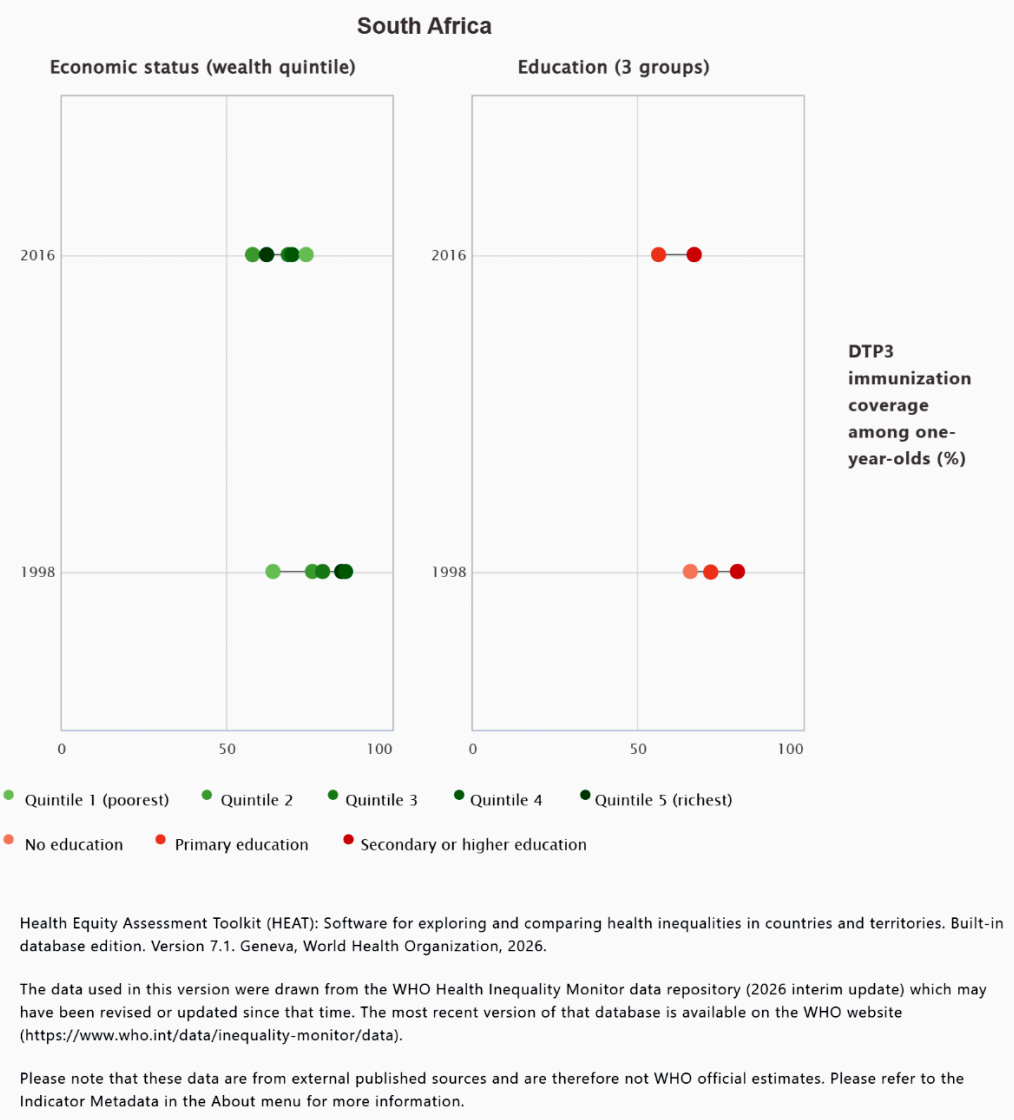
The figure illustrates how health inequality monitoring can reveal differences in DTP3 immunization coverage across socioeconomic and educational groups (Figure 1). Overall, coverage was relatively high, but differences between population groups were evident in both periods. In 2016, coverage across wealth groups was more closely clustered than in 1998, while differences by education level remained noticeable. These patterns demonstrate how disaggregated data can identify population groups experiencing lower coverage and help guide more equity-focused immunization planning and action.
Research focus areas
The HIM research portfolio is structured around three complementary areas:
Evidence generation
The portfolio aims to strengthen the generation and use of health inequality evidence within the South African health information system, with a focus on monitoring inequalities and inequities across priority health areas.
A current project focuses on institutionalizing HIM within the South African health system, using childhood immunization as a proof of concept. The project uses disaggregated health data and inequality measures to identify disadvantaged populations and generate evidence to inform equity-oriented policy and program action.
Methods development
The portfolio develops and applies approaches that strengthen the translation of health inequality evidence into policy and decision-making.
A current project integrates Health Inequality Monitoring, health policy analysis and public health informatics to facilitate the uptake and use of equity data and strengthen the application of an equity lens in health-system decision-making. The work seeks to establish a pathway from data generation and inequality measurement, through interpretation and policy analysis, to knowledge translation and decision support.
Capacity strengthening
The portfolio also focuses on strengthening capacity in Health Inequality Monitoring methods among Member States, researchers, policymakers, and other stakeholders.
Current and planned activities include:
- Science for Africa Foundation policymakers’ workshop: A three-day practical workshop on the HIM cycle, with a focus on using data for policymaking and data visualization. Addis Ababa, Ethiopia, 19–21 November 2026.
- Cochrane Colloquium 2026 workshop: Measuring health inequities in zero-dose children in the South African context, using the WHO HIM methodology. Kraków, Poland, 8–10 December 2026.
These activities aim to build practical skills in generating, analyzing, interpreting, visualizing, and communicating health inequality evidence for policy and decision-making.
Resources related to the work
Publications
- Jaca A, Mathebula L. Integrating Health Inequality Monitoring and Equity-Focused Policy Analysis for Immunization: A Conceptual Framework for Translating Data into Equity-Oriented Action. Vaccines. 2026;14(3):219. https://doi.org/10.3390/vaccines14030219
- Jaca A,Malinga T, Iwu-Jaja CJ, Nnaji CA, Okeibunor JC, Kamuya D, Wiysonge CS. Strengthening the Health System as a Strategy to Achieving Universal Health Coverage in Underprivileged Communities in Africa: A Scoping Review. International Journal of Environmental Research and Public Health. 2022;19(1):587. https://doi.org/10.3390/ijerph19010587
- Jaca A,Iwu-Jaja C. Research gaps on Universal Health Coverage in the South African context and other low- and middle-income countries; putting things into perspective: a scoping review. BMC Health Services Research. Accepted for publication.
Conference presentations
- Jaca A, Mathebula L. From data to policy: integrating health inequality monitoring and equity-focused policy analysis for immunization decision-making. 20th Vaccine Congress, Seville, Spain, 13–16 September 2026.
- Jaca A, Mathebula L. Strengthening capacity for health inequality monitoring in South Africa: building skills across the HIM cycle. 20th Vaccine Congress, Seville, Spain, 13–16 September 2026.
- Jaca A, Mathebula L. Measuring health inequities in zero-dose children in the South African context, using the WHO Health Inequality Monitoring methodology. Cochrane Colloquium 2026, Kraków, Poland, 8–10 December 2026.
- Jaca A, Mathebula L. Institutionalizing health inequality monitoring for immunization in South Africa: a proof-of-concept using disaggregated EPI Survey data. 5th Africa CDC CPHIA 2026, Addis Ababa, Ethiopia, November 2026.
Collaborations and Networks
WHO Health Inequality Monitoring (HIM) Network
The HIMEA research portfolio is affiliated with the WHO HIM Network, coordinated by the World Health Organization. The Network brings together institutions and technical partners committed to advancing health inequality monitoring globally and strengthening the use of equity-focused evidence to inform policy and decision-making.
Through this affiliation, the portfolio advances HIM through equity-focused evidence generation and synthesis, methodological innovation, training and capacity strengthening, and collaborative technical support initiatives.
Public Health Informatics, Data and Analytics (PHIDA)
PHIDA contributes informatics expertise to the Health Inequality Monitoring portfolio through data management, analytics, equity dashboards, and visualization. It supports the development of accessible decision support tools that translate inequality findings into evidence for policy analysis and program planning.
Norwegian University of Science and Technology
The portfolio collaborates with the Department of Public Health and Nursing at the Norwegian University of Science and Technology (NTNU) on complementary research examining how health inequality monitoring data are translated into government policies.
Science for Africa Foundation
The portfolio also collaborates with the Science for Africa Foundation (SFA) to strengthen the capacity of policymakers and researchers to use equity-focused evidence and evidence-based research in health policy and decision-making.
Looking ahead
Through research, methodological development, capacity strengthening and collaboration, the HIMEA portfolio aims to contribute to the institutionalization of HIM in South Africa and to strengthen the routine use of equity evidence in health-system policy and decision-making.
The longer-term vision is to move beyond measuring inequalities towards ensuring that equity evidence is translated into action to improve health outcomes for populations experiencing disadvantage.
Portfolio Lead: Dr Anelisa Jaca (anelisa.jaca@mrc.ac.za)
LinkedIn Profile: https://www.linkedin.com/in/anelisa-jaca-b201a040/
This portfolio represents a coherent and evolving programme of research activities focused on advancing the design, conduct, analysis, reporting, and interpretation of evidence synthesis methods. In line with the Cochrane Collaboration’s mission, it aims to enhance the rigour, transparency, efficiency, and usability of systematic reviews and related outputs to better inform health decisions.
Key activities include:
- Developing and evaluating risk-of-bias tools (e.g. RoB 2, ROBINS-I)
- Methods for incorporating non-randomised studies
- GRADE methodology and decision frameworks
- Rapid review methods and automation tools
- Qualitative evidence synthesis methodology
- Equity considerations in evidence synthesis
- Living systematic reviews and updating strategies
Project lead: Dr Lindi Mathebula (lindi.mathebula@mrc.ac.za)
About PHIDA
PHIDA is a professional body of work focused on strengthening the collection, management, structuring, analysis, and translation of health and research data into evidence for decision-making. The portfolio brings together work across clinical research informatics, data management and analytics, evidence and decision intelligence, and methods and capacity development, with a particular interest in practical approaches relevant to African health and research systems.
Mission
To apply public health informatics, data and analytical methods to strengthen data quality, interoperability, evidence intelligence and evidence-informed decision-making.
Objectives
- Strengthen the quality, management, accessibility and responsible use of health and research data.
- Improve how data are structured, connected and reused through informatics and interoperability approaches.
- Generate useful insights from health and research data through data interrogation, analytics, reporting and visualisation.
- Connect research data with evidence synthesis, policy analysis and decision-support processes.
- Develop practical, reusable tools, methods and guidance for public health informatics and analytics.
- Build and share capacity in data management, informatics, analytics and evidence-to-decision approaches.
Workstreams
PHIDA is organised around four interconnected work streams.
Focuses on the practical management, quality assurance, extraction, curation, interrogation and analysis of health and research data. This includes registry data management, data completeness and validation, data extraction and preparation, data cleaning and curation, data interrogation and descriptive analysis, routine and analytical reporting, data requests and secondary use, dashboards and data visualisation, and the preparation and quality assurance of structured registry data submissions
Focuses on the systems, standards and digital workflows that support clinical research and clinical trial registration. This includes clinical trial registry systems and workflows; research data systems and database architecture; REDCap and structured data capture; clinical research data standards; Fast Healthcare Interoperability Resources (FHIR) and Systematised Nomenclature of Medicine Clinical Terms (SNOMED CT); interoperability and structured search; registry workflow improvement; and governance and auditability.
Focuses on transforming health and research data into structured intelligence and evidence products to support research planning, evidence synthesis, policy and decision-making. This includes research and evidence intelligence, publication tracking, evidence mapping, research landscape analysis, evidence-to-policy informatics, dashboards and decision-support products, evidence cards and evidence briefs, and structured links between trials, publications, evidence synthesis and policy needs.
Focuses on making PHIDA approaches practical, reusable and transferable through tools, guidance and capacity strengthening. This includes frameworks and methodological approaches, reusable templates, data dictionaries and technical documentation, analytical and decision-support tools, training and workshops, practical demonstrations, technical guidance and knowledge sharing.
Current Projects & Collaborations
This work includes registry data management, data quality and completeness checks, data curation, extraction and interrogation of registry data, analytical reporting and dashboards, stakeholder reporting, WHO-ICTRP data submissions, and ongoing improvement of registry systems and workflows.
Continuous improvement project to strengthen clinical trial registration workflows, including SANCTR-to-PACTR integration, data validation processes, change controls, reporting, and approaches to reducing duplication while maintaining registry governance and auditability.
This project explores how African clinical trial registries can move beyond registration towards more connected evidence pipelines, including structured data, interoperability, evidence synthesis and research intelligence. It includes developing and piloting a prototype to link registered trials with publications and transform them into structured research intelligence for evidence synthesis and decision-making.
A collaborative programme with the Health Inequality Monitoring & Equity Analysis portfolio explores how disaggregated health data can identify inequalities and how inequality monitoring can inform policy analysis and decision support. PHIDA contributes to developing practical products that help translate analysis into decision-ready information, including dashboards, evidence cards, evidence briefs, equity profiles, policy brief structures, data dictionaries and related technical resources.
Portfolio Lead: Dr Ebrahim Samodien | ebrahim.samodien@mrc.ac.za
High-quality research only achieves its full value when it informs decisions, influences practice, and improves people's lives. At Cochrane South Africa, our Research Translation portfolio works to ensure that evidence does not remain confined to journals and reports but reaches the people who can use it, including communities, healthcare professionals, policymakers, researchers, and funders.
This portfolio supports researchers in planning for impact from the earliest stages of a project through to implementation, uptake and evaluation. Our approach recognises that research translation is not a once-off communication activity, but an ongoing process that should be embedded throughout the research lifecycle.
We develop and support a range of evidence-informed products and activities designed to make research accessible, relevant and actionable. These include plain language summaries, policy-relevant outputs, podcasts, webinars, newsletters, social media campaigns, media engagement, stakeholder workshops, and other innovative approaches to knowledge sharing.
A growing focus of the portfolio is understanding how research is used, identifying barriers to uptake, and helping researchers design more meaningful pathways from evidence to action. By strengthening the connection between research, policy, practice and communities, we aim to promote evidence-informed decision-making and maximise the real-world impact of health research in South Africa and beyond.
“Medicine is a social science and politics is nothing else but medicine on a large scale...medicine as a social science, as the science of human beings, has the obligation to point out problems and to attempt their theoretical solution; the politician, the practical anthropologist, must find the means for their actual solution”.
(Rudolf Virchow so-called founder of ‘social medicine’)
This portfolio of work seeks to develop a critical social and behavioural science (SBS) for, and of, the evidence-based healthcare landscape in South Africa, Africa and more broadly. The specific objectives are to: 1) Undertake critical SBS research for, and of, the evidence-based healthcare landscape; 2) Provide training, support and mentorship in conducing and interpreting critical SBS research within the evidence-based healthcare landscape; 3) Translate our critical SBS work for consumption by other research and non-research stakeholders so that it has an impact within research, policy and practice
What do we mean by “social and behavioural science” (SBS)?
The social and behavioural sciences include a range of disciplines e.g. anthropology, psychology, sociology, economics with a broad shared focus on understanding individual thoughts, emotions, and behaviors and social practices. In the context of public health, SBS offers insights into the ‘how’ and ‘why’ of health and illness, and is increasingly valued as part of a complex, people-centered approach to tackling multifaceted public health challenges.
What do we mean by “critical”?
A ‘critical’ SBS seeks to reimagine dominant ways of understanding by analysing power structures and relations; unsettling widely held assumptions in public health and uncovering the roots to health problems that lie within social systems and institutions.
More information about our SBS portfolio work is available here, including our flagship Qualitative Evidence Synthesis (QES) Hub
The main role of Cochrane SA is to provide training and support to Cochrane authors in countries for which it is the reference centre. In addition, Cochrane SA is involved in a number of projects which promotes evidence-based practice and policy.