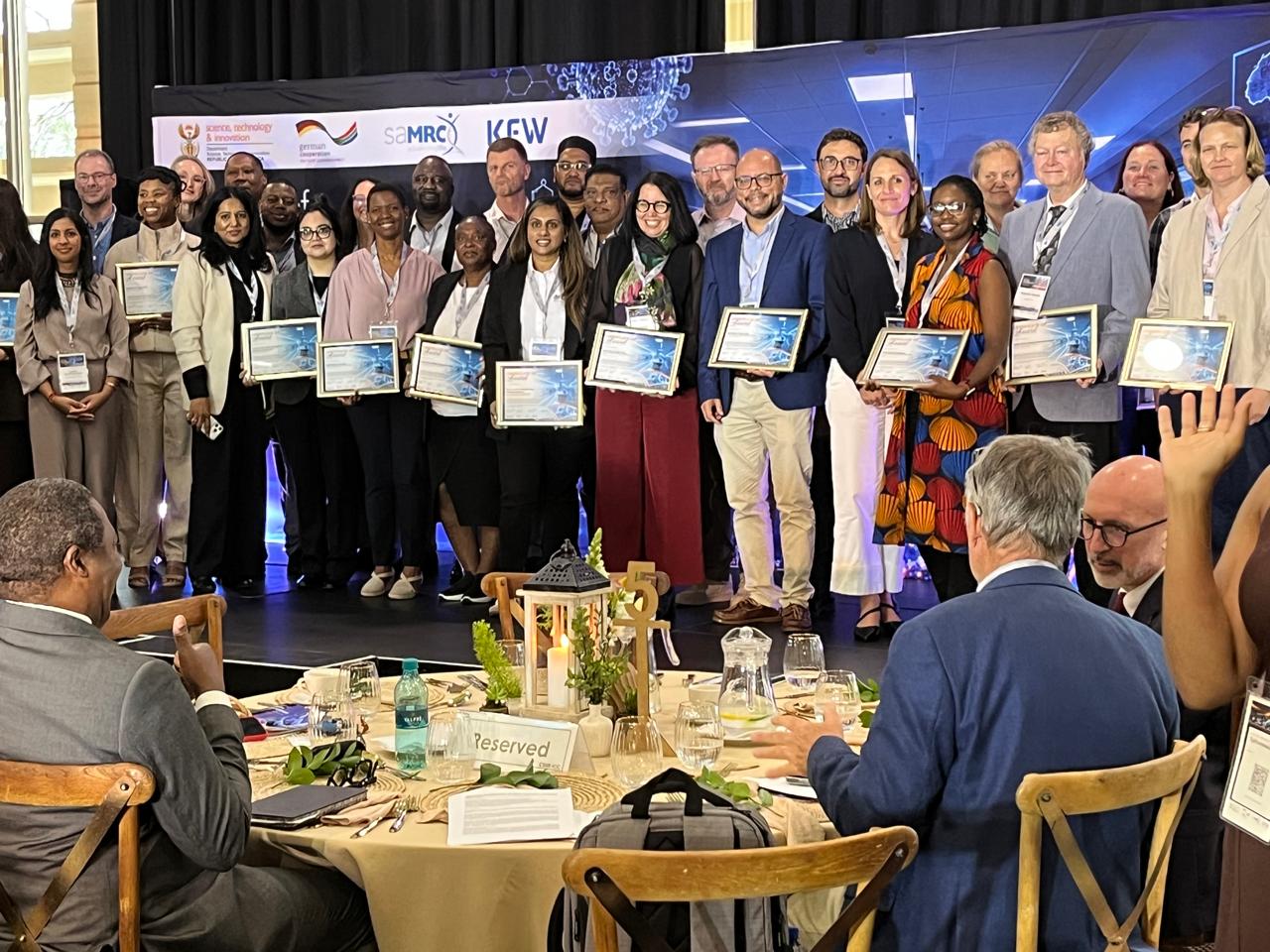
A major South African-German partnership to strengthen the country’s ability to research, develop, and produce vaccines while building scientific, technical, and regulatory capabilities was recently celebrated.
The event acknowledged the contribution of the Project's beneficiary institutions and showcased the impact of this important partnership between the Governments of South Africa and Germany.
Through the initiative, the German Government has committed €20 million in grant funding over five years to support vaccine research and development, pilot-scale production, regulation and manufacturing capacity in South Africa.
The agreement was formalised in July 2023 between the Department of Science, Technology and Innovation (DSTI) and KfW Development Bank, acting on behalf of Germany’s Federal Ministry for Economic Cooperation and Development.
The DSTI appointed the South African Medical Research Council (SAMRC) as the Project Executing Agency.
Implementation began in 2024 through an open, competitive national Request for Applications, with proposals assessed by international experts for technical merit, relevance, institutional suitability and potential impact.
The process concluded in December 2024 with awards to 19 project beneficiaries. The beneficiaries are distributed across four areas of support: three in pilot vaccine production, 13 in research and laboratories, two in training, and one in regulation.
Together, these beneficiaries span South Africa’s vaccine development value chain. They include vaccine manufacturers and biotechnology companies, universities and research institutions, specialised preclinical and laboratory facilities, training platforms and regulatory capacity.
Among them are Afrigen Biologics, the CSIR’s Biomanufacturing Technology programme and Wits VIDA/Rubic One Health, which are strengthening pilot-scale vaccine production. Research and laboratory beneficiaries include Biovac, CAPRISA, North-West University’s Preclinical Drug Development Platform, two SAMRC facilities, the Primate Unit and Delft Animal Centre (PUDAC) and IT Services Division, the South African National Control Laboratory for Biological Products at the University of the Free State, Stellenbosch University, and several specialist vaccine and bioprocessing research units at the University of Cape Town and University of the Witwatersrand.
The investments range from sophisticated laboratory and bioprocessing equipment to pilot production capability, digital infrastructure, preclinical testing facilities, quality-control systems and specialised training. Collectively, they are designed to strengthen the pathway from scientific discovery and preclinical research through to pilot production, regulation and ultimately local vaccine manufacturing
SAMRC President and CEO Professor Ntobeko Ntusi said the partnership addresses lessons highlighted by the COVID-19 pandemic and Africa’s continued dependence on external vaccine supplies. “Our ambition must be to move from vaccine dependence to vaccine autonomy, from scientific participation to scientific leadership, and from technological vulnerability to sustainable health security,” he said.
DSTI Deputy Director-General: Research Development and Support, Mr Imraan Patel, said the initiative should be viewed as more than a standalone vaccine project. “We should see this investment as part of a broader effort to strengthen South Africa’s capacity to develop and manufacture essential health products, contributing to technological sovereignty and building capabilities across the value chain.”
Mr Enrico Brandt, Deputy Head of Mission at the German Embassy, described the programme as an investment in “resilience, scientific and industrial capability, and South Africa’s capacity to develop, test, regulate and ultimately manufacture health products that respond to its own priorities.”
The training component of the initiative at the CSIR also receives significant investment from the EU and contributes to wider European efforts to strengthen African biomanufacturing. Mr Fulgencio Garrido Ruiz, Deputy Head of the EU Delegation to South Africa, emphasised that manufacturing capacity does not rest on infrastructure alone: “It is built with people and with an ecosystem.”
For KfW Development Bank Country Director Mrs Cornelia Tittmann, the investment is ultimately about people and long-term capacity. “Each recipient we honour today represents more than an investment in institutions, buildings or equipment. Each one is an investment in South Africa’s people, their skills, their research capability and the long-term health security of this country.”
Together, the partners are laying foundations for a more sustainable vaccine ecosystem that can strengthen South Africa’s preparedness while contributing to vaccine security across the African continent.